
Lead Routing to Independent Sales Agents
Inbound inquiries to the responsible commercial sales agent
The sales-agent reality
An independent sales agent is contractually a contractor on commission, not an employee. They carry their own tax, insurance, and business overhead, and often hold agent contracts with several manufacturers in parallel. In industries like machinery, industrial goods, high-end building products, or security technology this is an established sales model: the manufacturer does not run an in-house field-sales team but works through agents who bring their own customer and industry knowledge.
That makes lead distribution mechanically related to in-house field-sales routing (territory, specialization, appointment-driven consultative selling) but qualitatively different: the manufacturer competes with other principals for the same agents’ attention. A lead that arrives after three days with poor context is declined or ignored; a well-priced lead with clear context that arrives within minutes wins priority. Lead routing becomes a competitive advantage in the agent market.
Three things that set sales-agent routing apart
- Contract-faithful territory routing. Unlike with an in-house field-sales team, agent territories cannot be informally reshuffled, they are contractually binding. Routing rules must reflect this precisely, with clear escalation paths on non-acceptance instead of informal redistribution.
- Commission context on the lead. The agent is not employed; they earn per close. Lead value and commission rate should be carried with the lead, as custom fields that are visible in the portal. On accept the agent sees what the inquiry is potentially worth and prioritizes rationally.
- Competition with other principals for attention. Because many agents represent multiple brands in parallel, you are not only competing for the end customer; you are competing for your agent’s reaction time. Fast lead handoff, transparent commission context, and low-friction acceptance in the mobile portal are not comfort features here, they are sales hygiene.”
Requirements and how leadtributor solves them
| Requirement | leadtributor solution |
|---|---|
| Contract-faithful territory routing | Territory tags per agent (postal-code ranges, regions, industry clusters); routing rules match the lead’s region consistently |
| Specialization match | Additional tags per agent (product line, industry); tags on the lead drive the match in shared territories |
| Commission context on the lead | Lead value, commission rate, order band as custom fields; visible in the agent portal on accept |
| Reaction escalation | Configurable stages before acceptance; reassign to the backup agent or senior escalation at the manufacturer |
| Backup rules | Active/paused tag on the agent plus a configured backup; escalation as an additional safety net |
| Mobile-first | PWA on any device, no app-store install; tel: and maps links integrated |
| Long sales cycles | Activity and stage documentation across the full cycle; auto follow-up on stall |
| ERP integration for commission accounting | Public API, webhooks, and connectors via Zapier/n8n push close data to your ERP. leadtributor itself does not maintain commission workflows |
| Reporting | Per agent and territory: response time, acceptance rate, appointment rate, close rate, order value |
How this differs from in-house field sales
Mechanically, independent sales agents and in-house field sales are closely related: fixed territories, appointment-driven consultative selling, long cycles, high-value capital goods. Legally and commercially they differ significantly:
- Self-employed vs. employed. The agent carries their own economic risk, they prioritize leads rationally by expected commission, not by internal hierarchy. That makes commission context on the lead a real lever.
- Contractual territories vs. internal allocation. With an in-house team the manufacturer can reshuffle territories at any time; with sales agents that is a contract matter with compensation claims. Routing must therefore match the contractual territory definition precisely.
- Multiple principals. Field-sales reps work for you only; agents often for several brands. Reaction speed, lead quality, and commission clarity determine whether your lead gets priority.
From a software perspective: the same routing and reporting model as for in-house field sales, but different configuration of escalation windows, different required fields on the lead (commission context), stricter territory discipline in routing.”
Which industries benefit most
Manufacturers in industries where sales agents are traditionally established: machinery and plant engineering (machine tools, special-purpose machines, industrial robotics), industrial goods and drive technology (motors, pumps, gearboxes, hydraulics), high-end building products (premium windows, conservatories, roofing systems), security technology (access control, video surveillance), tool and workshop machinery, industrial fittings and specialist parts.
Next step
See in 30 minutes how leadtributor would look against your agent network: with your contractual territory definitions, your commission structures, your ERP connection, and the adjustment to the attention competition your agents face with other brands.
How it works
- Step 1
Aggregate lead sources from manufacturer marketing
Manufacturer website with industry-specific inquiry forms, trade-show capture, performance campaigns on B2B platforms, referral and reference forms, phone hotline. The lead carries structured data immediately: product interest, industry, location, lead-value band, optional preferred appointment as a custom field.
- Step 2
Route along contractual agent territories
Sales agents in leadtributor are tagged with territories that correspond to their contractually defined area: typically postal-code ranges, regions, or industry clusters. Plus product specializations, if an agent only represents part of the manufacturer's portfolio. Routing rules match the lead's region against those tags, contract-faithful.
- Step 3
Lead arrives with the agent, including commission context
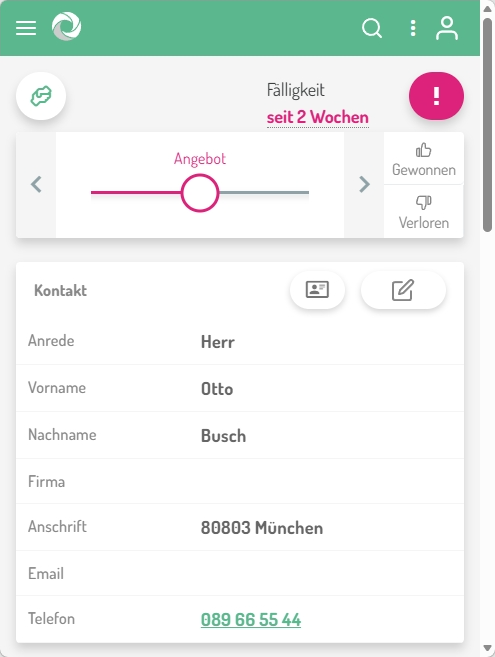
The agent sees the lead in the leadtributor portal (a PWA that runs on any device: smartphone in the car, tablet at the customer, laptop in the office). With customer intent, project volume, the configured commission rate or lead value as a custom field, preferred appointment, and source. On accept the agent sees what the inquiry is potentially worth, and prioritizes rationally.
- Step 4
Acceptance, appointment booking, consultative sale
The agent accepts or declines with a reason (capacity, no match, territory outside contract). On non-acceptance, escalation runs: reassign to the configured backup agent or senior escalation to the manufacturer. Appointment booking with the customer happens afterwards in the agent's calendar; the agreed appointment is captured back as a custom field on the lead.
- Step 5
On-site appointment, quote, close, track the commission base
The agent documents appointment outcome, quote, negotiation stages, and close in the portal. Per agent and territory you see: response time, acceptance rate, appointment rate, close rate, order value. Commission calculation itself runs in your ERP; leadtributor exports close data via the public API as the basis.
Frequently asked questions
How does routing along contractual agent territories work?
Each sales agent is set up with their contractually defined areas as tags: typically postal-code ranges, regions, or industry clusters. On lead arrival leadtributor matches the customer's region from the lead against the tags and routes contract-faithfully. For overlapping or joint territories (e.g. two agents in the same region with different product lines) the routing rule decides based on additional lead and agent tags.
Can we make commission rates or lead values visible to the agent?
Yes. Lead value, commission base, or a configured commission rate can be carried as custom fields on the lead and shown in the agent portal. On accept the agent sees directly what the inquiry is potentially worth. The actual commission accounting runs in your ERP; leadtributor does not maintain a commission workflow, but exports close data via the public API as the basis.
What happens if a sales agent does not accept an inquiry?
You define escalation stages before acceptance: typically a push reminder after 24h, reassign to the backup agent or senior contact after 48h, optional channel-manager notification at the manufacturer. With agents who work for multiple brands in parallel, reaction speed is often the differentiating factor; escalation logic catches stalled leads automatically.
How do we handle agents who also work for other brands?
From leadtributor's perspective this is transparent: you see only your own leads and sales data in the agent portal, and the agent sees the leads of each principal separately. Strategically the commission-context setup and reaction-time escalation help: a well-priced lead that arrives quickly and is shown transparently wins the agent's attention in the competition with other principals.
Can we configure backup rules for sickness or longer absence?
Yes, through an active/paused tag on the agent plus a configured backup agent. When the primary agent is inactive, leadtributor automatically forwards new leads to the backup. The normal non-response escalation acts as an additional safety net.
How do we connect leadtributor with our ERP for order and commission data?
Through public API and webhooks. Close data, order values, and stage changes are pushed from leadtributor into your ERP, which then handles commission calculation and payout. Connectors via Zapier or n8n are also possible if direct ERP integration would be heavy.
How do we see which agents are performing strongly or lagging?
In reporting per agent: response time, acceptance rate, appointment rate, close rate, average order value. From there a clear picture emerges of which agents are strong in their territory and where coaching or routing adjustments would help. The data basis is transparent and avoids disputes between agents and the manufacturer.
Lead Routing to Independent Sales Agents
Request a demo